
I Thought I Was Fine. Then My Body Told the Truth.

A journey into clean pain, community healing, and the ancient wisdom that lives beneath male silence.
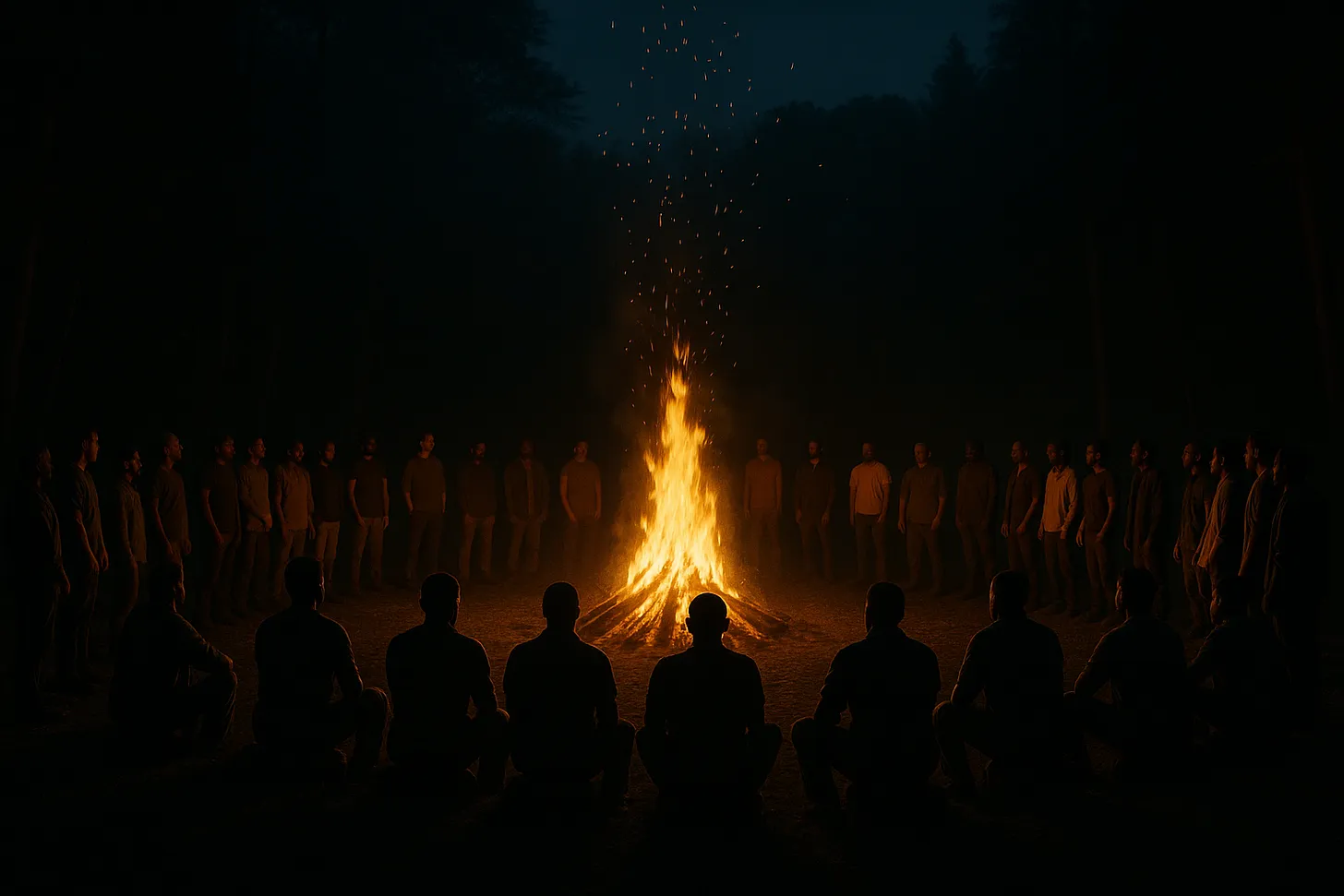
Special thanks to the men who walked this path with me and made the experience truly unforgettable.
The Mirror in the Fire
The hardest thing I have ever done as a man is to look squarely in the mirror with full, sustained attention. To courageously face myself with unflinching honesty. To meet the truth beneath the stories: acknowledge and tend to the fear, grief, anger, shame, failure, desperation, abandonment, anguish, and all the experiences I would rather not feel.
Resmaa Menakem calls this clean pain. When met directly, it transforms suffering into coherence, growth, and wholeness. It is the pain we meet when we stop numbing and avoiding, when we choose vulnerability over performance, when we step forward with no promise of comfort or outcome. And I have learned that it is best not to do this alone. Wounding happens in relationship, and the medicine is found there too.
In March of 2025, I discovered Embodied Masculine, founded and guided by Amir Khalighi. I joined their Wednesday Men’s Embodiment Circle, a two hour, skillfully facilitated practice of breath, movement, stillness, sound, touch, and visualization. These sessions revealed a truth I had long understood but had not fully lived: healing requires the body. It demands practice, presence, and shared experience.
Seven months later I made the bold commitment to join the four day Firekeepers Men’s Retreat, an immersion in the ancient conversation between physiology and psyche, in sacred honesty, and in what is deeply human. It arrived at a moment when I was losing my way. Firekeepers slowed me down, shook something loose, and invited me to face the truths I had been outrunning. It invited me to stay in the fire long enough to burn away illusion and feel what the body had long held.
A Community of Care
Judith Herman reminds us that recovery can take place only within the context of relationships. It cannot occur in isolation. That truth revealed itself fully at Firekeepers.
If Firekeepers taught me anything, it is this: whatever we carry, we do not have to carry it alone. Healing is not a solitary act but a shared ceremony. I stood among forty men, forty mirrors, forty hearts witnessing one another’s courage. Some roared, some wept, some trembled, some prayed. Together we created a field of belonging where breath, sweat, grief, joy, and truth became the medicine we offered one another. Community did not just hold the work. It made the work possible.
Among the men were stories too heavy to carry alone. Some were walking through divorce or the grief of losing a parent. Others were confronting cancer diagnoses, porn addiction, childhood abuse, or the quiet ache of a life that had drifted off course. I will never share their stories, but I can say this: every man carried something real, something tender, something deeply human. And in that shared humanity, something in all of us began to soften and open.
In the months since, this lesson has only deepened. I find myself turning toward the men in my life with new intention and tenderness: my brothers, sons, nephews, cousins, friends, and mentors. Strength is not isolation but connection. It is not stoicism but reciprocity. The greatest wisdom across all my explorations is simple and undeniable: I cannot heal alone. None of us can. We need circles of care, accountability, and love to become the men we are meant to be.
Descent into the Body
bell hooks once wrote that the wounded child inside many males is a boy who was taught that to feel is to be weak. I felt that truth in my bones when I first entered Embodied Masculine’s practice space.
For years I have sat in men’s circles speaking truth, weeping, confessing, and being witnessed. Yet Embodied Masculine was different. It invited my body to breathe, to speak, and to remember. I could not think my way across the threshold. Healing required focused attention on what was rising inside me. I have practiced yoga, sat in sweat lodges, danced in ceremony, and walked other healing paths. Still, that first Wednesday night session was unlike anything I had ever encountered. It was a deep exploration of the inner emotional ecosystem that felt unrestricted, unashamed, and free.
That night something ancient stirred. I remembered the dancer I once was, the boy who leapt and twirled until middle school insisted boys do not dance. I remembered wanting to be a gymnast before boys are not supposed to do that closed that door. In another life I might have become a professional dancer, muscles alive with strength and grace, the body fluent in its own language. Now my hips pop, my back complains, and my breath sometimes catches, but still I move. I move without choreography or permission. I move because something inside me must be witnessed. In movement, I free myself from the cage of rigid masculinity.
The Body’s Ferocity, The Body’s Tenderness
Peter Levine teaches that the body has been designed to heal itself if we give it the right conditions. Firekeepers created those conditions.
One morning, pain tore through my stomach, sharp, sudden, and insistent. I left the temple half bent, searching for breath and water. One of the Embodied Masculine sentries stayed with me for a moment, steady and present, until instinct called me toward the fire. I removed my shirt and lay directly on the grass, my chest pressed to the cool earth.
“I need you. I need you,” I whispered. “Tlāzocamati Tonantzin. Thank you with all my heart, Mother Earth.”
The ground received me without judgment. My pain became prayer. My body, after years of bracing, softened into the earth’s embrace. My pierced side relaxed, surrendered, and released the pain. Ferocity and tenderness lived side by side, alive, necessary, and welcomed.
We need this. Men need this. For years I understood intellectually that trauma lives in the body. But knowing is not integrating. Understanding is not healing. At Firekeepers, the body finally had its say. Breath became truth telling. Movement became memory. Sound became release. Stillness became revelation. And honesty rose not as crafted sentences but as tremors, sweat, tears, and the unmistakable surge of something long confined finally breaking free.
Integration and Growth
Gabor Maté reminds us that the attempt to escape from pain creates more pain. This retreat taught me to stop escaping it.
In the two months since Firekeepers, I have felt quiet but unmistakable shifts in my nervous system. I am not spiking as often, and when I do, I can calm myself more quickly. Grief comes in waves I can now feel, allow, and release. I am softer with myself, more empathetic, and more honest without bracing. Truth telling, once sharp and punishing, has become gentler and more spacious. My breath has deepened, and my Wednesday practice continues to anchor me. I am honoring my body through exercise, stretching, and presence, and the body in return is teaching me how to stay.
These shifts are changing how I show up in relationships. I am calmer, even under stress, with a steadier sense of accountability and a more grounded integrity. I have reached out for help, now working with a new therapist. I have re-rooted myself in community through calls with close friends, voice messages on WhatsApp (a practice modeled by my wife and her best friend), long walks with my mentor, and more time with family. Connection feels essential. Spiritually, I feel more humility and a deeper sense of belonging to something larger. I still have work ahead, especially around older wounds, but I am exploring my inner landscape with new willingness, tenderness, and a healing commitment I had not accessed before.
Returning with Gratitude and Fire
I did not leave Firekeepers fixed or finished. I left with something truer: a commitment to keep feeling, keep practicing, and keep walking this path with others. The retreat gave me a way back to myself, and it also awakened something larger, a remembrance that men heal in motion, in community, in breath, and in truth. The body remembers the way. A deeper life waits when we stop running from ourselves.
I move through the world more slowly now, more intentionally, more willing to tell the truth and allow others to hold me through it. My shadows remain, but I meet them with less fear. I feel more open, more grounded, and more connected to something greater than myself. There is still work ahead, but I no longer walk alone. I have brothers beside me, practices within me, and a path that feels worthy of my life.
I carry deep gratitude for the facilitators, for the courage of the men, for the meals that nourished us, and for the land that received what my body could no longer hold alone. And above all, I left with a fire, an ember of integrity that still burns in me. It reminds me that to heal as men, we must gather. We must risk honesty in our bodies. We must practice. We must remember what it feels like to be alive together. Firekeepers did not just change my life. It gave it back to me, one breath, one movement, one honest moment at a time