
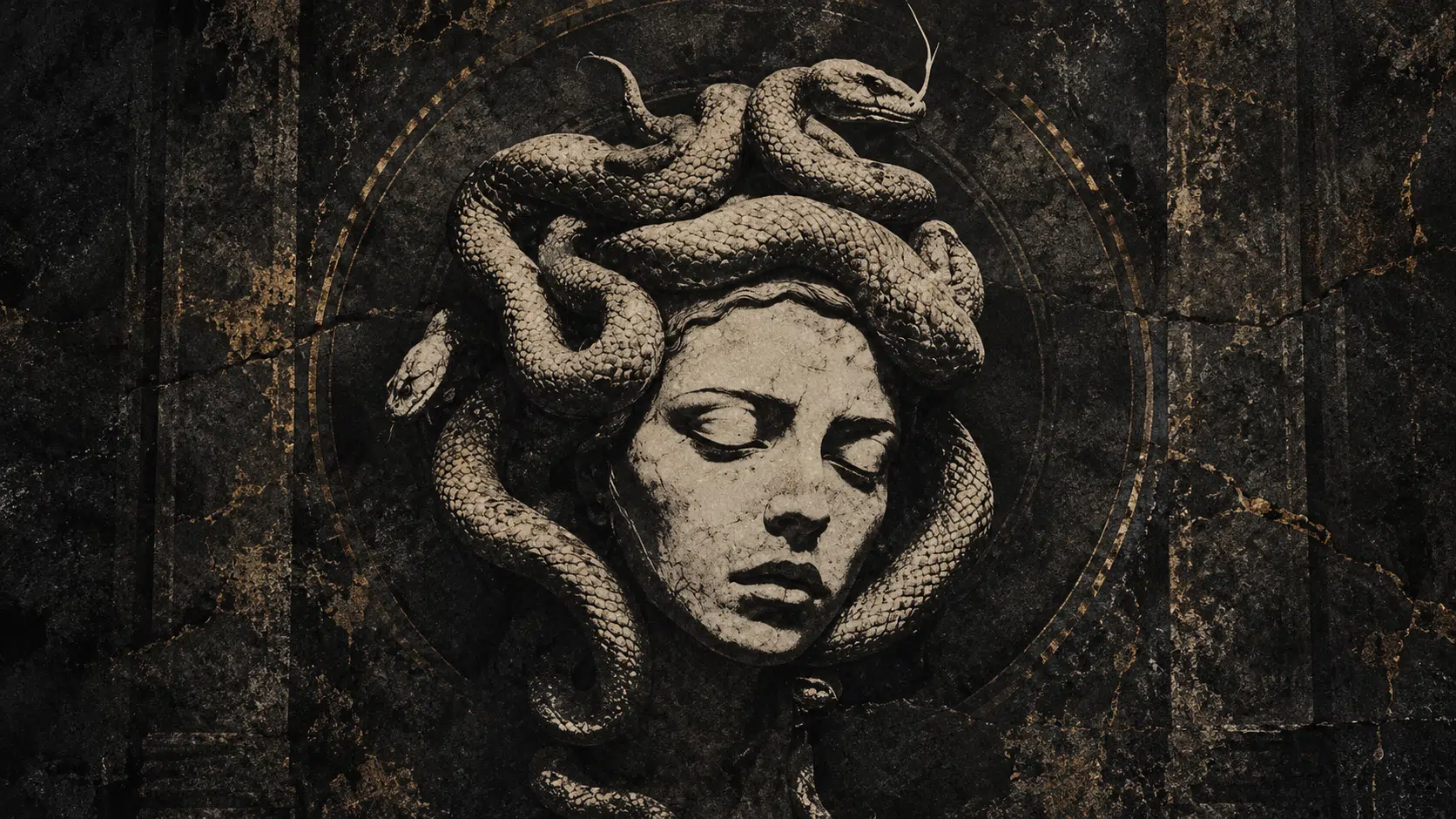
Medusa
Temple of the Serpent
A descent into the gaze, the serpent, and what the body knows beneath language.
- Coming Soon
What cannot be controlled is often first taught to us as something to fear.

Enter the Temple
What we exiled did not disappear. It learned to live beyond the walls.
Every family, culture, religious faith, and institution teaches us what is acceptable and what is not. In time, those judgments become internalized. We learn which parts of ourselves are welcome, and which must be hidden, softened, silenced, or abandoned in order to belong.
The same thing happens with power. What will not submit is called excessive, and what cannot be governed is named dangerous, even evil. Look at how the Crone, the woman who no longer lives under the spell of being desired, is so often made invisible, marginalized, and discarded. Whatever cannot be easily assimilated becomes suspect, then forbidden, and finally monstrous.
Medusa stands at that crossing point.
Yet she is more than the one who was feared and made monstrous. She is the one who looks back. The feminine has so often been placed in the position of being looked at: desired, judged, protected, possessed, idealized, condemned, and defined from outside itself. Medusa reverses that gaze. She sees what happened to her, she sees what was projected onto her, and she sees the structures and identities that required parts of her to disappear.
The old story says that whoever meets her eyes is turned to stone, and it is worth wondering what that stillness is. Perhaps part of what petrifies is the shock of being seen by what we had agreed not to see. Her face was not only an image of terror. The Gorgon was also placed at thresholds, on shields, temples, graves, and doorways, where something needed protection.
So the question changes.
What if the monster is not what threatens the sacred?
What if the monster is what guards it?
And if that is true, then perhaps the parts of us we learned to fear are not simply problems to overcome. Perhaps some of them have been standing watch over something we were not yet ready to reclaim. What stands watch that long, unseen and unaddressed, does not stop perceiving. It develops a gaze of its own. It remembers what was surrendered, and it knows what the surrender has cost.
What happens when what you have judged, controlled, silenced, or exiled is finally allowed to look back at you?
- What did you learn to exile in order to belong?
- Who did you become to remain safe, loved, or accepted?
- And what in you has been waiting beyond the walls?
Medusa is not the subject of the evening. She is the reflection gazing back at us.
Beyond what we were taught to fear lies what can only be known by entering.

Beneath the Serpent Canopy
A voice goes quiet when speaking costs belonging. A boundary weakens when refusal threatens connection. Instinct is abandoned when someone else's authority becomes more trusted than our own direct knowing.
These adaptations are not failures. They are strategies. The mask may once have protected you.
This is not an evening devoted to becoming more powerful. It is an evening devoted to discovering what your power has been protecting, what your adaptations have cost you, and whether the identities that once kept you safe still need a place in your life.
This workshop is an invitation to meet what lived and breathed beneath those adaptations, and to give the parts of yourself you have learned to control enough space, at last, to speak.
Within the ritual of the evening, we will move before explanation takes over, and breathe beneath the identities we have learned to maintain. We will use the voice for something other than agreement, performance, or control. We will notice where the body contracts, where it refuses, where it wants to move closer, and where it needs distance. We will stand before one another and notice what happens in us when we are truly seen. And we will encounter what has been exiled without immediately trying to fix it, release it, or turn it into another story.
Some of what returns may be rage. Some may be grief. Desire. Instinct. Boundary. Tenderness. Power. Silence.
The work is not to unleash these forces. It is to become capable of meeting them consciously, and of remaining present beneath their gaze without controlling them, destroying them, explaining them away, or turning from them. To listen for what they have been protecting. To discern what still belongs in shadow, what asks for integration, and what is ready to return to life. Nothing here is pushed toward catharsis for its own sake.
This work belongs to men and women alike because what Medusa reveals is not confined to one gender. The feminine is not synonymous with woman, and the impulse to control it is not synonymous with man. All of us inherit ways of controlling what feels dangerous, silencing what threatens belonging, distrusting instinct, performing identities for acceptance, and projecting onto others what we have not yet been willing to meet in ourselves.
So Medusa has something different to reveal to each person who enters. For one the encounter concerns voice, for another boundary, for another sexuality, control, or shame. For some, and perhaps especially for men, it is the capacity to remain present while another person looks back. Men do not come here to understand women, and women do not come to reclaim a feminine power. Everyone enters beneath the same question.
What becomes possible when I stop turning away from what I have been taught to fear?
A serpent does not tear itself free of its old skin, or argue with it. It grows until the old form no longer fits, then moves slowly through a narrow place and leaves behind what once protected it. It is fitting, perhaps, that the serpents live in Medusa's hair, so close to the eyes that see.
The serpent teaches what the body already knows: every form that shelters life must one day make way for what is becoming.

As the Sun Descends
We gather as the daylight begins to leave. Over four hours the evening moves down, and back.
- 6:00Arrival
Still some light.
- 6:30Threshold
What stays at the door.
- 7:00Descent
The light goes, and so does the face we arrived with.
- 7:45Encounter
Direct contact with what looks back.
- 9:15Integration
Letting what was seen settle.
- 10:00Return
Out into the night.
Times are approximate

Medusa: Temple of the Serpent
- Dates
- Coming Soon
- Capacity
- 13 Participants
- Open To
- Men & Women
The gathering is held to thirteen participants. This is not a question of availability but of the container itself: work that concerns being seen asks for a circle small enough that every person in it can be.
Notify me when this offering becomes available.
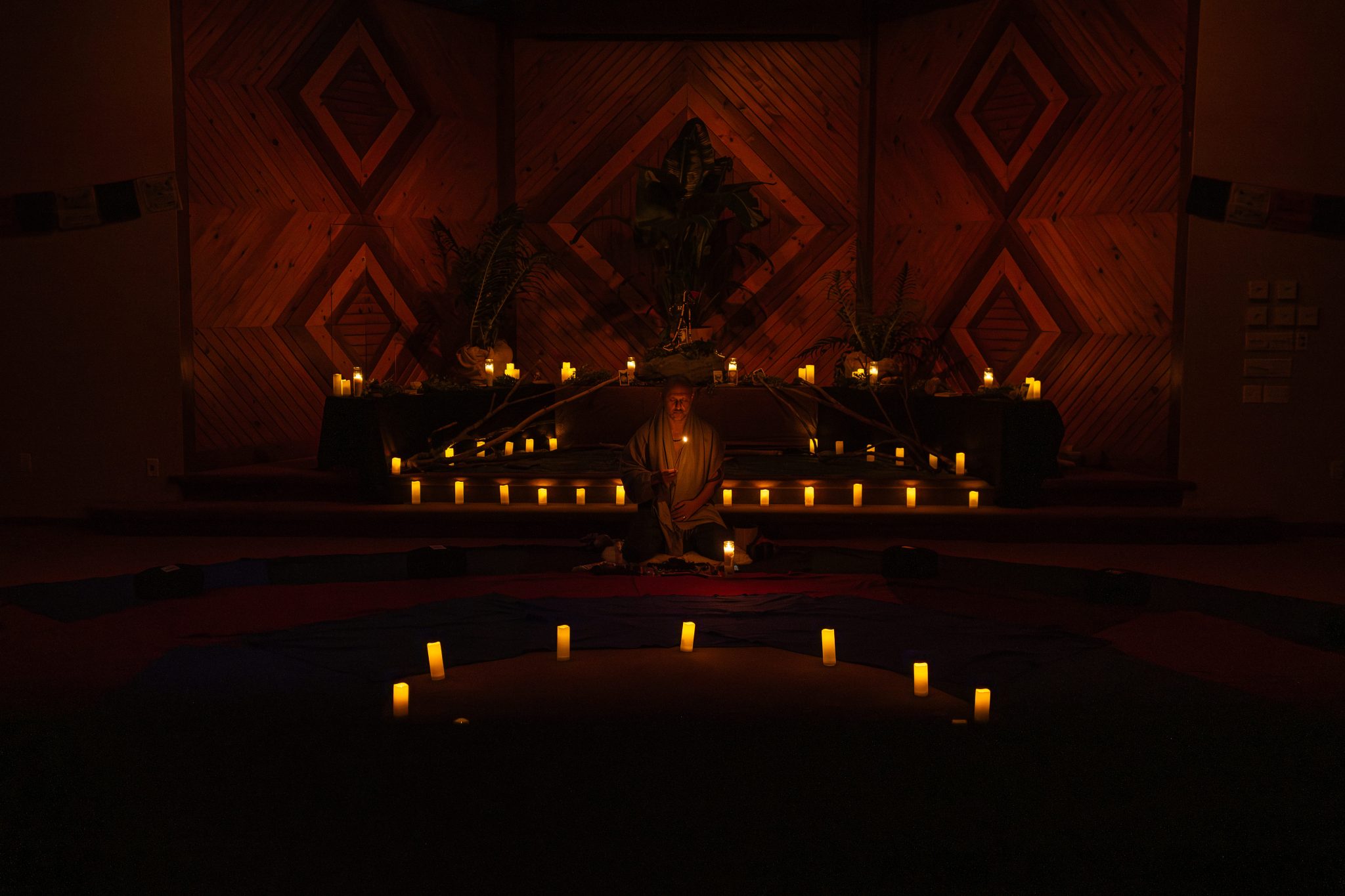
Held By
Amir Khalighi
Amir Khalighi is the founder of Embodied Masculine™, working at the intersection of embodiment, depth psychology, somatic practice, ritual and archetypal inquiry, and drawing on decades of practice in Tibetan Buddhism, Hermeticism, shamanic traditions and deity yoga. He does not approach archetypes as ideas to be studied, but as living forces met through the body, through relationship, and through ritual. For this evening, that means carrying Medusa out of mythology and into encounter, as a presence to be met rather than a story to be interpreted.
Founder, Embodied Masculine™
Some thresholds are crossed by understanding. Others ask for the body.
Enter the temple.
Notify Me
Medusa: Temple of the Serpent
Coming Soon
13 Participants · Open to Men & Women